How to Pre-Register at the Hospital for Delivery
Published November 9, 2026
Pre-registering at the hospital for delivery means giving the hospital your personal, insurance, and provider details ahead of time so that, when labor starts, staff can focus on you instead of on a clipboard. Here is when to do it, what to bring, and what to expect.
What pre-registration is (and isn't)
Pre-registration is an administrative step. You provide your name, contact information, insurance, and your care provider so the hospital can create a record before you arrive. It is not a medical appointment, and in most cases it is not required — but many hospitals encourage it because it shortens admission when you show up in labor.
It also isn't a guarantee of a bed or a binding choice. If your plans change, for example you switch providers or hospitals, you can usually update or redo it.
When to pre-register
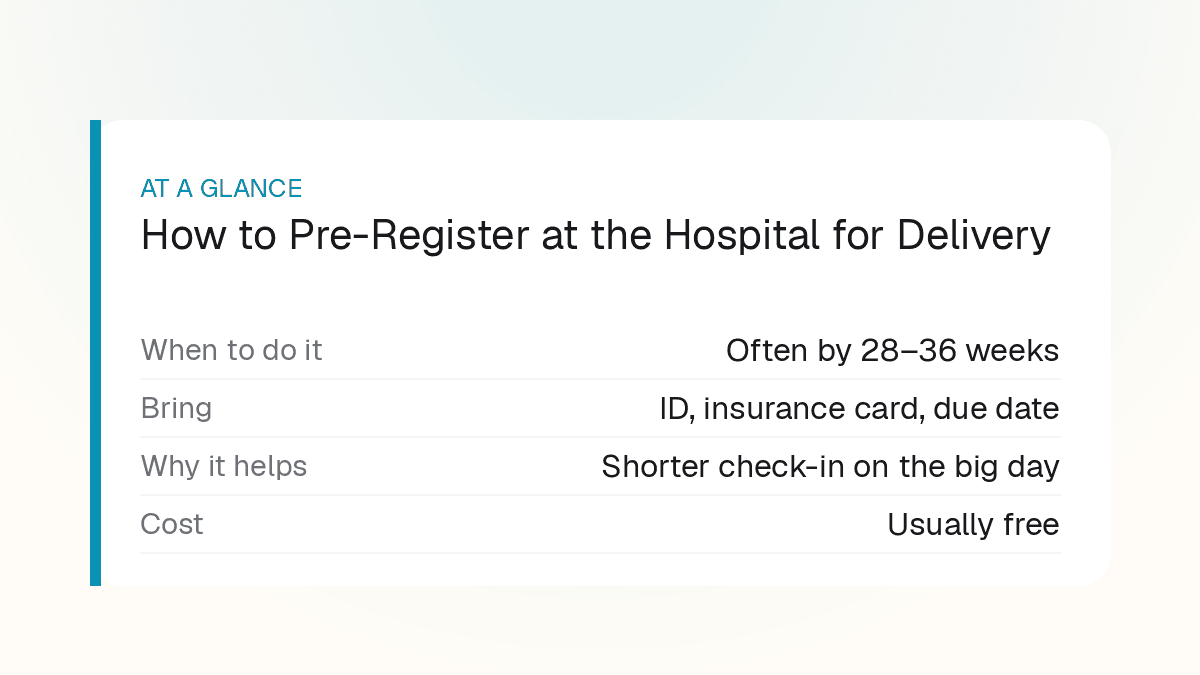
Policies differ, but many hospitals suggest completing pre-registration somewhere in the second half of the third trimester, often between about 28 and 36 weeks. Some accept it earlier, and some only open it after a certain point. The simplest approach is to ask your provider's office or call the hospital's labor and delivery or registration desk and ask what they recommend.
Ask your provider first
How to pre-register, step by step
1. Find the right channel
Look on the hospital's website for "maternity," "labor and delivery," or "pre-registration." Options typically include an online form, a phone call, a paper form from your provider, or an in-person visit during a hospital tour.
2. Gather what the form asks for
- Your legal name, date of birth, address, and phone number.
- Photo ID — you may be asked to show it at admission as well.
- Insurance card with member and group numbers, plus the policyholder's details.
- Your due date and your OB, midwife, or practice name.
- Emergency contact and your partner or support person.
- Your baby's pediatrician, if you've chosen one (see how to choose a pediatrician).
3. Review consent and billing forms
You may get general consent forms and information about billing. Read them at your own pace now — it is far easier than at 3 a.m. between contractions. Ask the hospital about anything unclear, and ask whether they offer a cost estimate based on your insurance.
4. Save your confirmation
Keep any confirmation number or screenshot, and bring your ID and insurance card to the hospital anyway. Pre-registration speeds things up; it doesn't replace them.
What pre-registration helps with later
- Faster check-in when labor starts, so you reach a room sooner.
- Fewer insurance surprises, since coverage can be verified in advance.
- Smoother birth paperwork. Hospitals usually collect the details used for the birth certificate shortly after delivery, so having names and spellings settled early helps. See our guide to getting your newborn's birth certificate.
Insurance questions are normal
Related to-dos while you're at it
Pre-registration pairs well with a few other third-trimester tasks: take the hospital tour if offered, write a birth plan, and pack your hospital bag. Put your pre-registration confirmation, ID, and insurance card in the bag so they are never an afterthought.
Key takeaways
- Pre-registration is an administrative step that speeds up admission; it is usually optional but often encouraged.
- Many hospitals suggest doing it around 28–36 weeks — confirm timing with your provider and the hospital.
- Have your ID, insurance card, due date, and provider details ready, and still bring them on the day.
- Ask about in-network status and cost estimates with your insurer and the hospital billing office.
Pre-registration is just one item in a long pre-baby to-do list. FirstDays turns the whole thing — hospital forms, insurance, birth certificate, Social Security number — into a personalized checklist with reminders, tailored to your state (see the state guides). Start free.
Get your personalized checklist — free
FirstDays builds a deadline-aware checklist for your state, reminds you before every window closes, and drafts the letters and forms for you. Free to start.
Build my checklist →