How to Write a Birth Plan: What to Include (With a Template)
Published November 5, 2026

A birth planis a short, written summary of your preferences for labor, delivery, and the first hours after birth. It isn't a contract and it won't decide how your birth actually goes — but it's one of the most useful ways to think through your choices ahead of time and get everyone on your care team on the same page. This guide walks through what to include, how to keep it to a single page, and when to write it.
What a birth plan is — and isn't
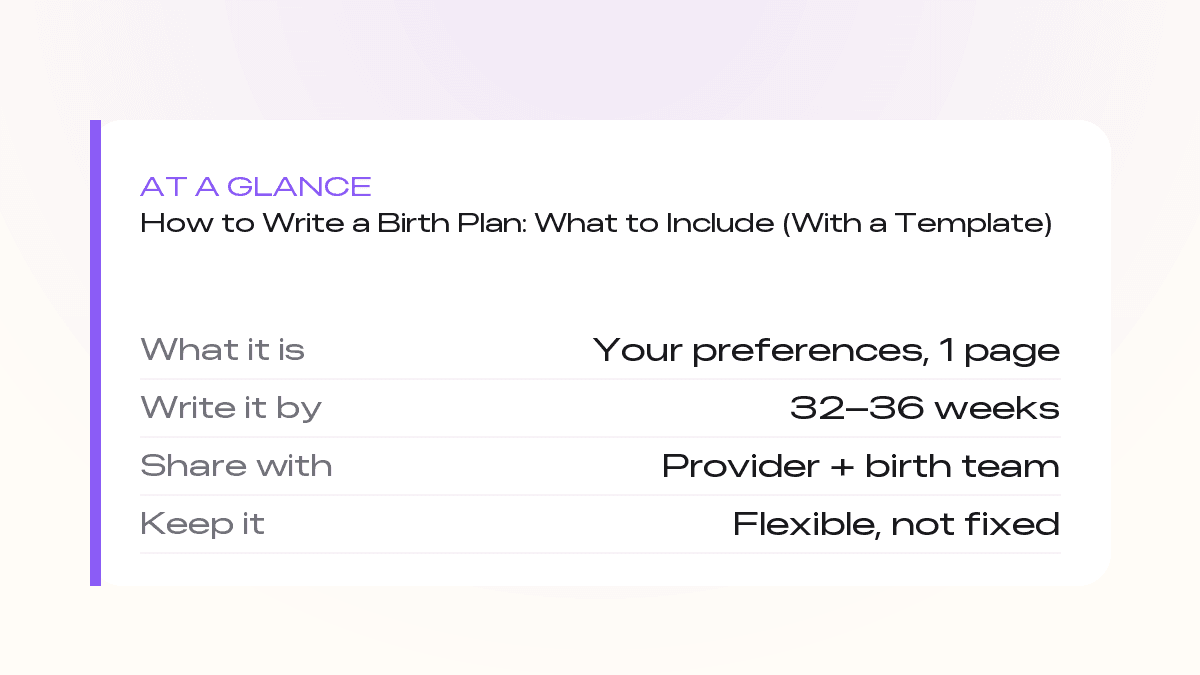
Think of a birth plan as a conversation starter, not a script. The goal is to show your provider and nurses what matters most to you so they can honor your preferences where it's safe and possible. Births are unpredictable, and plans often change in the moment for good medical reasons. The parents who find a birth plan most helpful treat it as a flexible set of priorities rather than a fixed list of demands.
Keep it to one page. A short, scannable plan is far more likely to be read by a busy labor-and-delivery team than a multi-page document. Use plain language and bullet points, and put your most important preferences at the top.
Talk it through with your provider first
When to write your birth plan
Aim to have a draft by 32 weeks and a final version by 36 weeks, so you can discuss it at a prenatal appointment and pack copies in your hospital bag before labor could begin. Print two or three copies: one for your chart, one for your partner or support person, and one to keep with your bag.
What to include in your birth plan
You don't need to cover everything — focus on the choices that matter most to you. These are the sections most parents find worth including:
The basics
- Your name, your due date, your provider, and where you plan to deliver.
- Your birth partner or support people, and anyone you want present (or not).
- Any allergies, medical conditions, or past birth experiences the team should know.
Labor preferences
- Environment: dim lights, your own music, freedom to move around or use a birthing ball.
- Pain management: whether you'd like an epidural, prefer to wait and ask, or want to try unmedicated options first.
- Comfort measures: a birthing tub or shower, massage, or position changes.
- Monitoring: continuous vs. intermittent, if your provider offers a choice.
Delivery preferences
- Positions you'd like to try for pushing.
- Who you'd like to announce the baby's sex, or whether you want a moment to discover it yourselves.
- Preferences around interventions — ask your provider to explain their routine practices so there are no surprises.
After birth (the "fourth stage")
- Skin-to-skin contact and delayed cord clamping, if you'd like them.
- Feeding plan: breastfeeding, formula, or a combination — and whether you'd like a lactation consultant.
- Newborn procedures (vitamin K, eye ointment, first bath timing) — note any preferences and confirm the hospital's standard approach.
- Whether the baby stays in your room, and who can hold the baby first.
If plans change
Add a short line about a possible cesarean or other unexpected turns — for example, whether you'd still like skin-to-skin in the operating room if it's safe. Naming a backup preference ahead of time means you won't have to make every decision from scratch in a stressful moment.
This isn't medical advice
A simple one-page template
Copy this structure into a document, delete anything that doesn't apply, and fill in the rest in a sentence or two each:
- About me: name, due date, provider, delivery location, support people.
- During labor: environment, movement, pain management, monitoring.
- During delivery: pushing positions, interventions, preferences.
- After birth: skin-to-skin, cord clamping, feeding, newborn procedures, rooming-in.
- If things change: cesarean preferences, what matters most to me no matter what.
Key takeaways
- A birth plan is a one-page list of preferences — a conversation starter, not a contract.
- Draft it by 32 weeks and finalize by 36, then review it with your provider.
- Cover labor, delivery, and after-birth preferences, plus a note for if plans change.
- Keep it flexible — births are unpredictable, and safety comes first.
A birth plan gets you ready for the delivery; FirstDays gets you ready for everything that comes after it. We build your personalized new-baby checklist — birth certificate, Social Security number, insurance, and more — with reminders before every deadline, tailored to your state (see the state guides). Start free.
Get your personalized checklist — free
FirstDays builds a deadline-aware checklist for your state, reminds you before every window closes, and drafts the letters and forms for you. Free to start.
Build my checklist →