Daycare Waitlists: Why to Apply While Pregnant (and How)
Published November 11, 2026
If you plan to use child care, a daycare waitlist may be one of the earliest items on your to-do list, sometimes well before your baby is born. Infant spots are limited, and many programs fill up months ahead. Here is how waitlists work, when to start, and how to handle them without overpaying or overcommitting.
Why infant care fills up early
Infants need more staff per child than older kids, so programs usually offer fewer infant spots. State licensing rules set the allowed ratios, and they vary, so a center that is large overall may still have only a handful of infant openings. In many areas, demand is higher than supply, which is why waitlists exist at all.
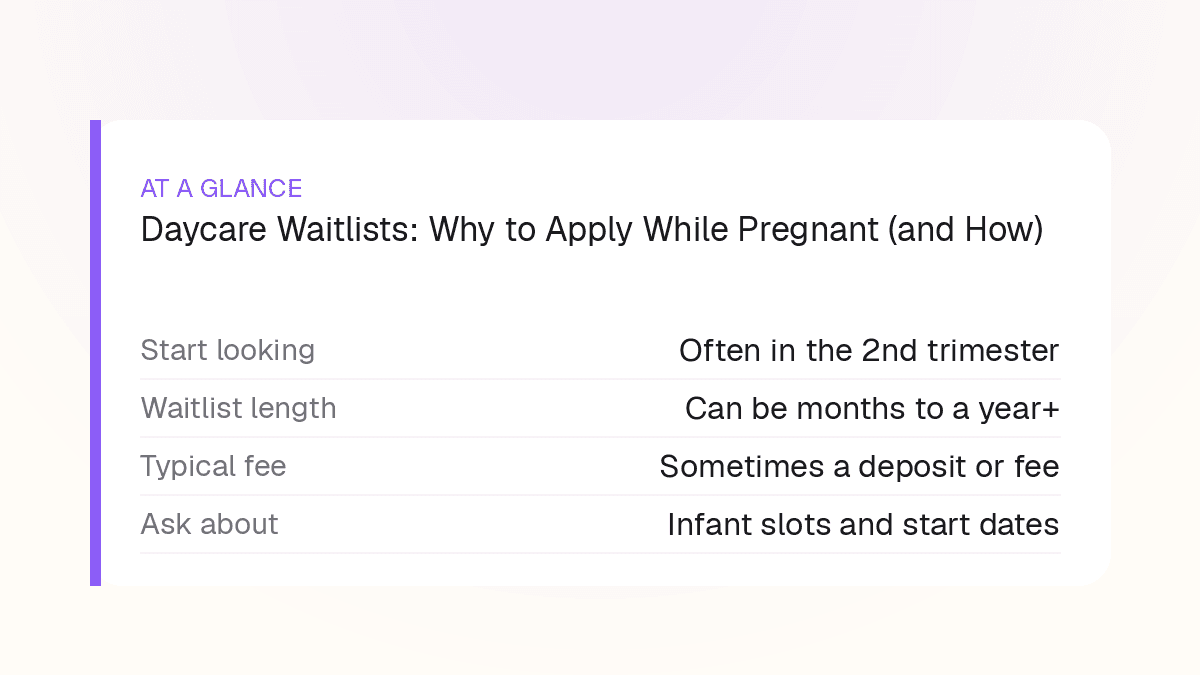
Because every program is different, there is no universal number for how long you will wait. Some have openings within weeks; others tell parents to join as soon as they have a due date. The only way to know is to ask the programs you are considering.
When to start
A common approach is to begin researching in the second trimester and contact your top choices soon after. If you live somewhere competitive, or you want a specific center, it can make sense to call even earlier. If you are more flexible, such as in-home providers or nannies, timelines are often shorter.
Work backward from your return date
How to get on a waitlist
1. Build a shortlist
Gather three to five options: centers, licensed family child care homes, and any employer-sponsored or community programs. Your state's child care licensing agency usually publishes a searchable list of licensed providers and inspection records, so check there for current details.
2. Ask these questions
- Do you take infants, and from what age (6 weeks, 3 months)?
- How does the waitlist work: first come, first served, or by age group and start date?
- Is there a waitlist fee or deposit, and is it refundable?
- How will I be notified of an opening, and how long do I have to say yes?
- What are tuition, hours, closure days, and late-pickup policies?
- What are your health, immunization, and safe-sleep policies?
3. Get the details in writing
Ask for the waitlist terms by email or on the form. Note your position or date joined, and what happens if you decline an offer. Policies on losing your place differ widely.
Costs, backups, and what to watch for
Some programs charge a one-time waitlist fee, and some ask for a deposit that is applied to tuition. Read the refund terms before paying, especially if you are joining several lists. Joining more than one is common, so it helps to track fees and deadlines in one place.
- Keep a backup plan. A relative, a nanny share, or a flexible provider can bridge a gap if your spot opens late.
- Update them after birth. Send the actual birth date and any change in start date.
- Check paperwork requirements. Programs usually ask for immunization records and a physician form once your baby is enrolled, so line up a pediatrician (see how to choose a pediatrician).
Official sources for costs and help
Key takeaways
- Infant spots are limited, so many parents contact programs during pregnancy; ask each one how long its waitlist runs.
- Count backward from your planned return-to-work date when choosing when to apply.
- Ask about fees, deposits, refunds, and what happens if you decline an offer, and get it in writing.
- Keep a backup plan and update each program after the baby arrives.
Waitlist calls are just one item on a long list. FirstDays turns the paperwork and to-dos into a personalized checklist with reminders, tailored to your state (see the state guides). Start free.
Get your personalized checklist — free
FirstDays builds a deadline-aware checklist for your state, reminds you before every window closes, and drafts the letters and forms for you. Free to start.
Build my checklist →