Parental Leave Paperwork: FMLA + State Paid Leave Explained
Published June 28, 2026
Parental leave is one of the more confusing parts of having a baby because three different things can apply at once: federal FMLA, your employer's own policy, and — in some states — a state paid family leave program. This guide untangles the parental leave paperwork so you know what to file and when.
FMLA: job protection, not a paycheck
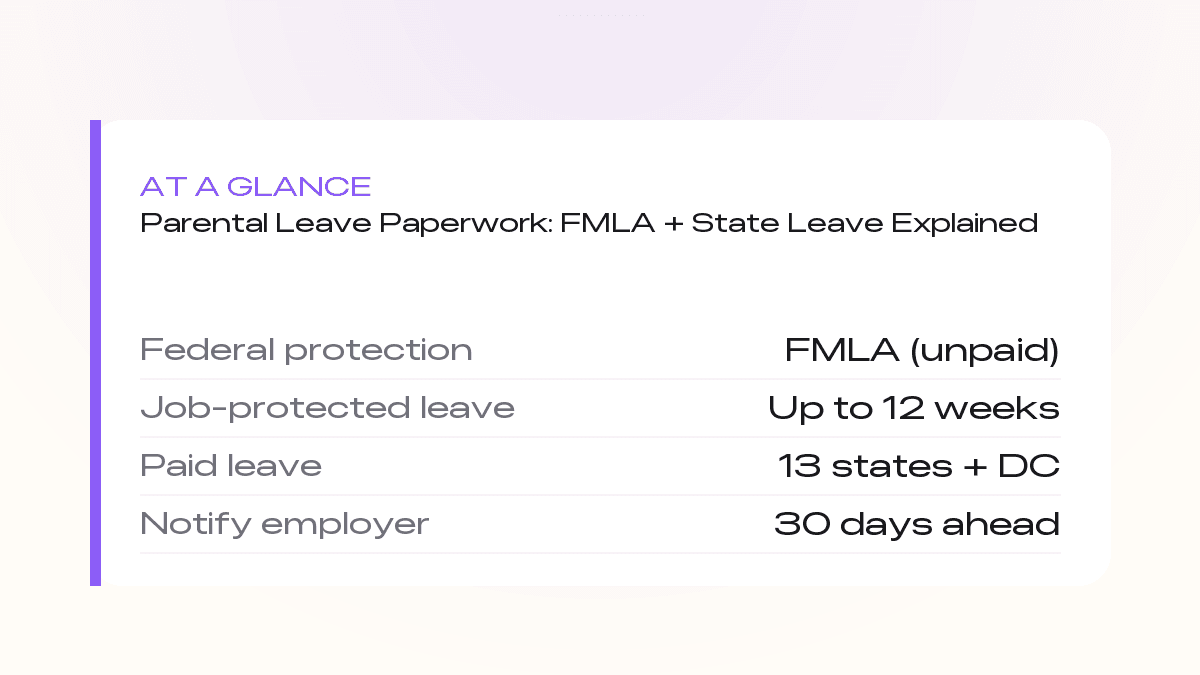
The federal Family and Medical Leave Act (FMLA) gives eligible employees up to 12 weeks of unpaid, job-protected leavefor the birth and care of a newborn. "Job protected" means your employer must hold your role (or an equivalent one) and keep your group health benefits. Key point: FMLA does not pay you — it protects your job.
Are you eligible?
- You've worked for your employer for at least 12 months.
- You've worked at least 1,250 hours in the past year.
- Your employer has 50+ employees within 75 miles.
State paid family leave: an actual paycheck
A growing number of states run paid family leaveprograms that replace part of your wages while you're out — including California, New York, New Jersey, Washington, Massachusetts, Connecticut, Colorado, Oregon, and others, plus Washington, D.C. Benefits, durations, and eligibility vary widely. Check your state's program in our state guides.
They can stack
What to actually file — and when
- Tell your employer early. FMLA generally requires 30 days' notice for a foreseeable birth; give written notice as soon as you can.
- Request leave in writing. A short, dated letter to your manager and HR stating your intended leave dates.
- Complete HR's forms. Many employers have an FMLA designation form and a benefits-continuation form.
- Apply to your state program (if you have one) — these are separate applications, often filed close to your leave start.
A simple leave-request letter
Your letter doesn't need to be fancy — name your expected leave start and end dates, reference FMLA and any state program, and ask HR what they need from you. FirstDays drafts this letter for you, addressed to your HR contact, ready to review and send.
Key takeaways
- FMLA gives up to 12 weeks of job-protected leave, but it's unpaid.
- 13 states plus DC offer paid family leave that replaces part of your wages.
- FMLA, state paid leave, and employer policy can run together — read all three.
- Give your employer written notice early — FMLA expects about 30 days for a birth.
FirstDays figures out which leave programs apply in your state and drafts your leave-request letter to HR. Build your free checklist.
Get your personalized checklist — free
FirstDays builds a deadline-aware checklist for your state, reminds you before every window closes, and drafts the letters and forms for you. Free to start.
Build my checklist →