Qualifying Life Event for Health Insurance: Adding Your Baby
Published November 10, 2026
A qualifying life event for health insurance is a major life change, such as having a baby, that lets you enroll in or change coverage outside the normal open enrollment period. Because the birth of a child is on that list, you generally do not have to wait for the next open enrollment to get your newborn covered. You do have to act within a deadline, though, so here is how the window works.
What counts as a qualifying life event?
Insurers and the Health Insurance Marketplace use qualifying life events (QLEs) to open a special enrollment period (SEP). Common examples include:
- Family changes: birth, adoption or placement of a child for adoption or foster care, marriage, divorce.
- Coverage changes: losing other coverage, aging off a parent's plan, or a job change that affects benefits.
- Moving: relocating to a new coverage area, in many cases.
Pregnancy by itself is not always a qualifying event, but the birth is. The exact list depends on whether you have employer coverage or a Marketplace plan, so confirm with your plan.
Official source
How long do you have to enroll your baby?
Deadlines are the part people miss. Typical patterns, which can vary by plan and state:
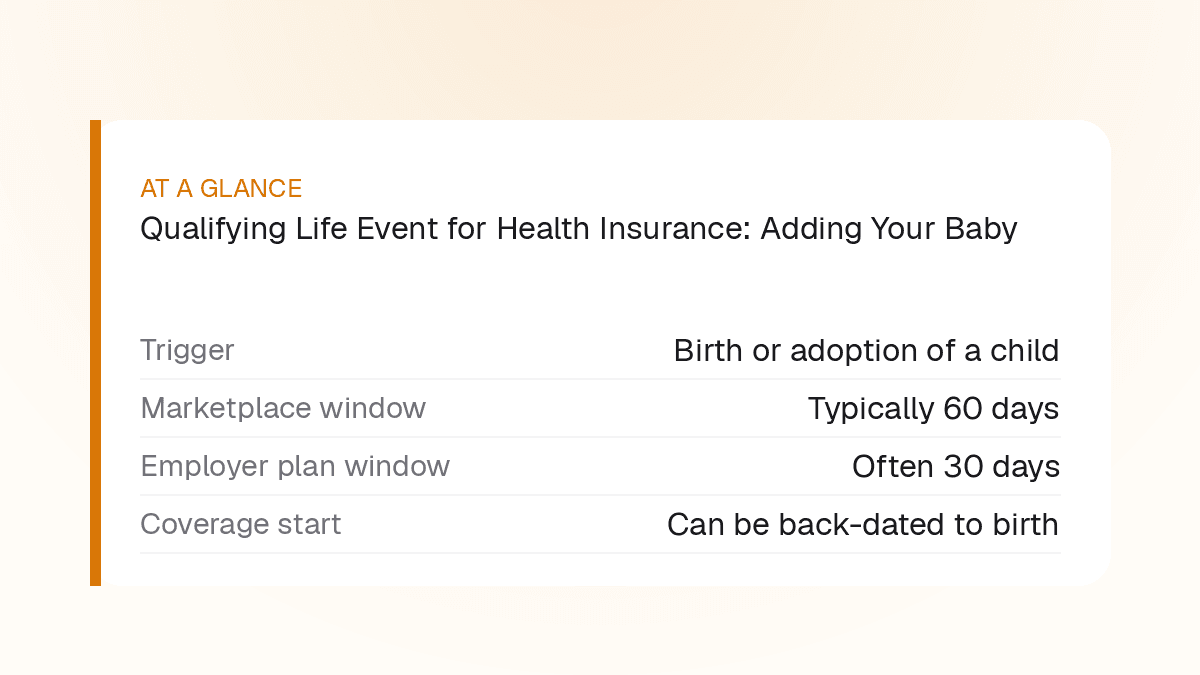
- Employer plans: often about 30 days from the birth, sometimes longer. Some plans require you to report the birth within a short window.
- Marketplace plans: typically a 60-day special enrollment period after the birth, and many plans can start coverage as of the baby's date of birth.
- Medicaid and CHIP: often have no fixed enrollment season, so you can usually apply anytime. See adding a newborn to Medicaid or CHIP.
Because rules differ, write the deadline down the day your baby is born and confirm it with your plan or HR.
How to add your newborn, step by step
1. Find your deadline
Call your insurer or benefits team and ask: "What is the deadline to add a newborn dependent, and what documents do you need?"
2. Gather documents
You may need the baby's name, date of birth and, later, proof of birth such as a certified birth certificate. Many plans accept hospital paperwork first and the official copy afterward. See how to get a birth certificate for a newborn.
3. Submit the enrollment or change
Add the baby through your employer's benefits portal or the Marketplace. If you are on a Marketplace plan, you may also be able to change plans for the household during the same window.
4. Keep confirmation
Save the confirmation and watch for the member ID card for your baby. A Social Security number is not always required up front; see the newborn SSN guide.
For a longer walkthrough of this step, read how to add a newborn to health insurance.
Don't wait for the card
What if you miss the window?
If the deadline passes, you may have to wait for the next open enrollment, and the baby could be uninsured in the meantime. If you are close to or past the deadline, contact your plan or HR right away and ask whether any exception or appeal exists, and check whether your baby may qualify for Medicaid or CHIP. For decisions about which plan is best for your family, a licensed insurance advisor or your benefits team can help.
Key takeaways
- The birth of a child is a qualifying life event that opens a special enrollment period.
- Employer windows are often about 30 days and Marketplace windows typically 60 days, but confirm yours.
- Enroll on time even if documents like the birth certificate are still pending.
- Medicaid and CHIP can usually be applied for anytime if you qualify.
FirstDays builds a personalized new-baby checklist with reminders before each deadline, including insurance. Browse the state guides or start free.
Get your personalized checklist — free
FirstDays builds a deadline-aware checklist for your state, reminds you before every window closes, and drafts the letters and forms for you. Free to start.
Build my checklist →