Certified vs. Informational Birth Certificate: What's the Difference?
Published November 7, 2026
When you order your baby's records, you may be asked to choose between a certified vs. informational birth certificate. They look similar on paper but are not interchangeable: only one is accepted as proof of identity and citizenship. Here is how they differ, which one you almost certainly need, and how to order it.
What is a certified birth certificate?
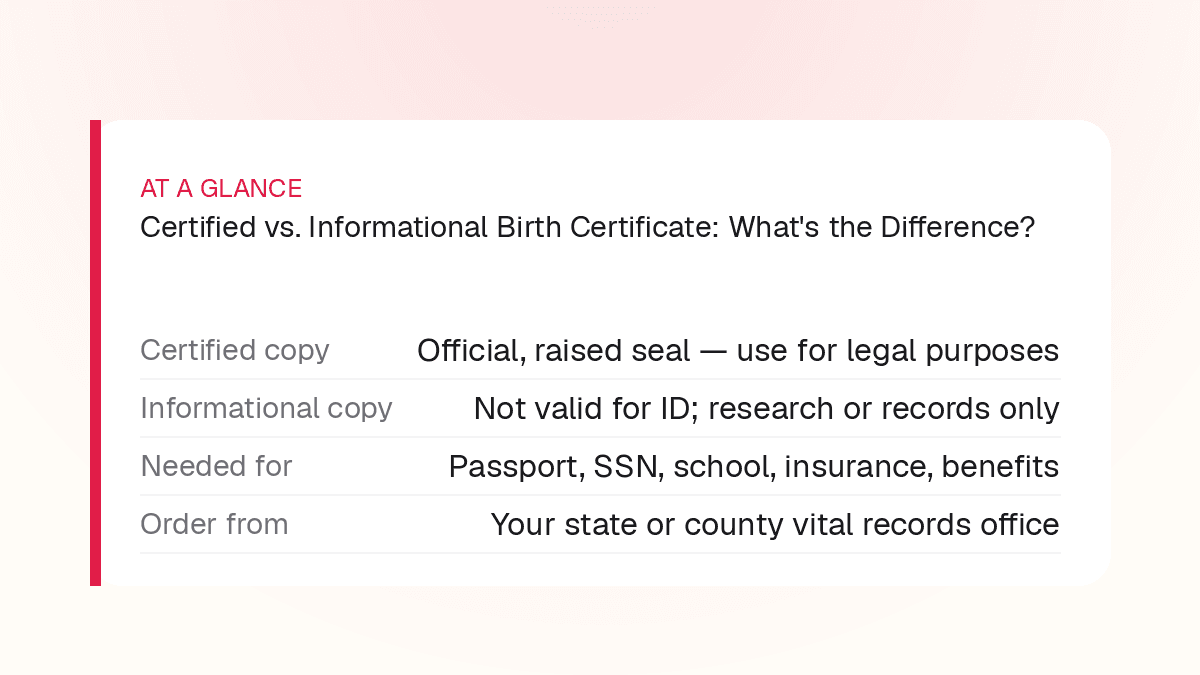
A certified copy is an official government-issued record of your baby's birth. It is printed on security paper, usually carries a raised or embossed seal or other security features, and is signed or stamped by the issuing vital records office. This is the version agencies mean when they ask for a "birth certificate" or an "official" or "long-form" copy. A photocopy of a certified copy is generally not accepted.
What is an informational birth certificate?
An informational copy contains the same facts but is marked something like "Not valid for legal purposes" or "For informational purposes only." It is typically used for genealogy, personal records, or research, and many states restrict who can get one less than they restrict certified copies. You cannot use it to get a passport, a driver's license, or most benefits.
The rule of thumb
When you need a certified copy
- Social Security number and card: see our guide to getting a newborn's SSN, which is often handled at the hospital.
- U.S. passport: a certified copy is required as proof of citizenship — see how to get a passport for a baby.
- Health insurance and Medicaid/CHIP: some plans ask for proof of birth when you enroll a dependent.
- School, daycare, and benefits: enrollment and many assistance programs ask for an official copy.
How to order the right copy
1. Identify the issuing office
Birth certificates are issued by the state or county vital records office where your baby was born, not where you live now. The CDC maintains a directory of state offices.
2. Choose "certified" and a quantity
Order forms usually list copy types. Choose certified, and consider asking for more than one — several agencies may want an original at the same time. Fees and processing times vary by state, so check the official site before you order.
3. Prove your identity
Parents named on the record can normally order. Expect to provide a photo ID and basic details such as the baby's name, date and place of birth, and parents' names. Use the official state site or its approved vendor, and be wary of look-alike sites that add large fees.
For the full process from the hospital worksheet onward, read how to get a birth certificate for a newborn.
Keep it safe
Common questions
Is the hospital souvenir certificate valid?
No. The decorative certificate with footprints is a keepsake, not a legal record.
Is a long-form different from a certified copy?
Some states issue short-form and long-form (full) certified copies. Agencies like the Passport Agency usually want the long form listing parents' names. Ask which your office issues.
Can I order an informational copy by mistake?
Yes, and it is a common time-waster. Check the form carefully before paying, and contact the vital records office if you are unsure which applies to your situation.
Key takeaways
- A certified copy is the legal version; an informational copy is not valid for ID or benefits.
- You need certified copies for passports, Social Security, insurance, and school enrollment.
- Order from the vital records office in the state where your baby was born, and consider extra copies.
- Rules, fees and wait times vary by state — confirm with your official vital records office.
Getting the right documents in the right order is half the battle with a new baby. FirstDays builds your personalized new-baby checklist with reminders before each deadline, tailored to your state (see the state guides). Start free.
Get your personalized checklist — free
FirstDays builds a deadline-aware checklist for your state, reminds you before every window closes, and drafts the letters and forms for you. Free to start.
Build my checklist →